· Sobre la moissanita
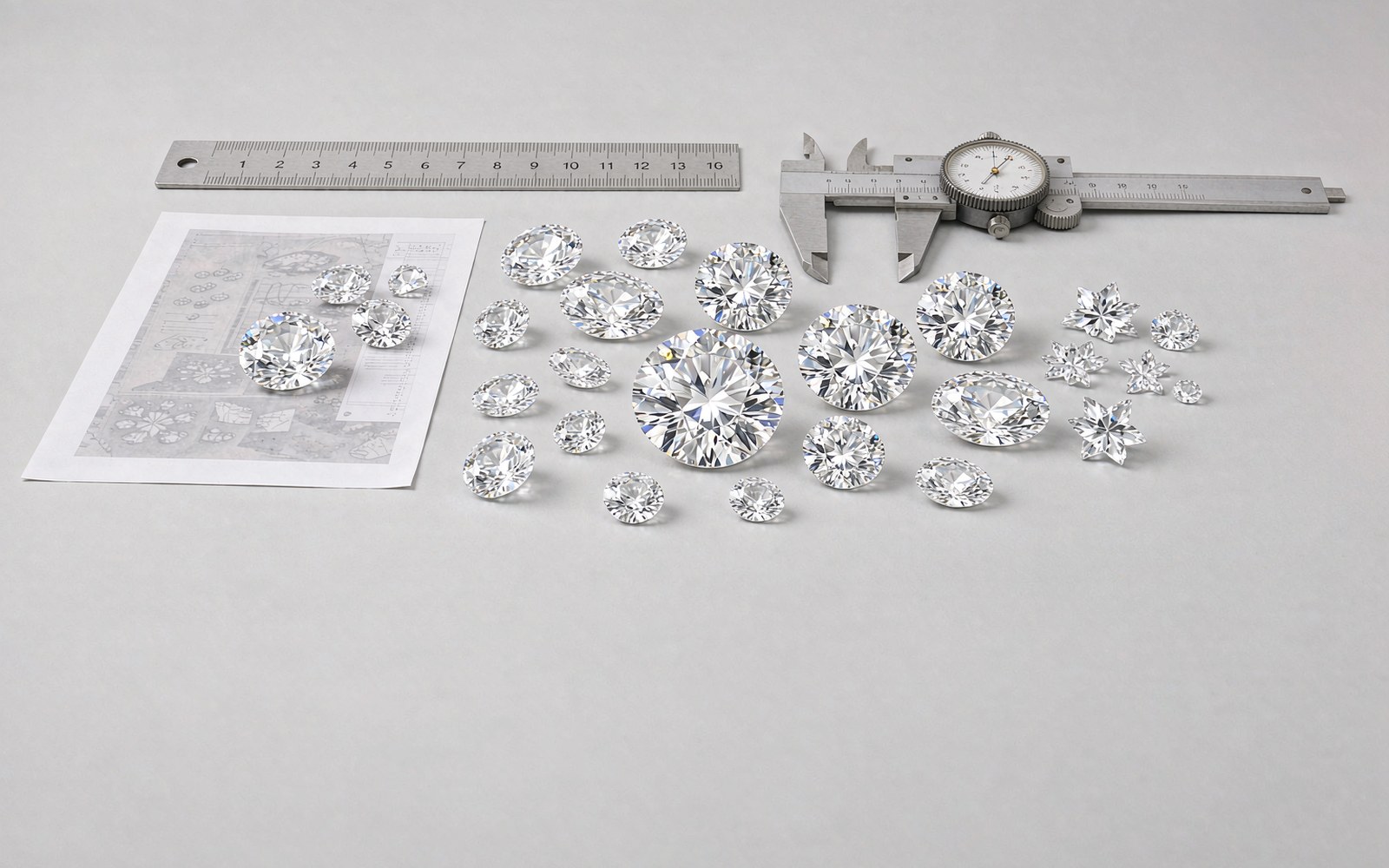
What is a moissanite specification sheet, and why does it protect your bulk order?
A specification sheet is the written definition of exactly what you will receive: the carat weight range, the cut shape, the metal, the dimensions, and the tolerance you accept on each. It is the single document your approved sample and your full production run are measured against. Buyers who skip it usually discover the mismatch only after the bulk order ships. See our explainer on what moissanite is before you write the first line.
Without a signed spec, 'high-quality moissanite' means whatever the supplier decides on shipment day. A spec sheet turns a vague promise into a checkable list. It also gives you footing in any inspection or after-sales discussion later.
Which specifications should I write down before requesting a sample?
Write these down before you ask for a sample, not after: carat weight per stone and its allowed tolerance; the cut shape, such as round, oval, pear, marquise, or a custom outline; the color range you accept, described in plain words such as 'near-colorless' rather than a single lab grade; the metal and plating; the setting type; and the physical dimensions with a tolerance in millimeters. Grading reports are available on request for confirmed orders, but the report describes one stone, not your whole batch.
Keep the language commercial, not promotional. 'Near-colorless, 925 sterling silver, round brilliant, 1.0 carat with plus or minus 0.05 tolerance' is a spec. 'The best stone' is not. The more numeric the tolerance, the easier the sample is to verify.
How do I make sure the bulk order matches the approved sample?
Ask the supplier to keep your approved sample on file and to reference its serial or photo in the production contract. Require that the bulk run is inspected against that same sample, and state the acceptable deviation in writing. For higher-value lines, request a grading report per stone or per batch so you can confirm the run tracks the sample. This is the inspection step most first orders forget.
A practical verification method: before paying the balance, ask for a small pre-shipment sample pulled from the actual production lot, then compare it side by side with your approved sample under the same light. If the supplier will not provide one, treat that as a signal.
What order quantities and MOQ logic should I expect from a moissanite supplier?
Minimum order quantities exist because cutting, setting, and plating have fixed setup costs that only spread across a run. The logic is usually tiered: a higher quantity unlocks a lower unit cost, and a heavily customized spec raises the minimum because the tooling is non-reusable. Ask the supplier to state the MOQ in writing and to confirm whether it changes with customization, then bake that number into your first trial order.
A safe first batch is one you can sell or return without strain, not the supplier's largest price break. Structure the trial around a single spec you have already sampled, so the only variable is volume, not quality.
How does my specification affect the production lead time?
Lead time is driven by how far your spec sits from the supplier's standard catalog. Stock shapes and standard settings ship faster; a custom cut, a custom outline, or a mixed batch of several specs adds setup and queue time. Sample approval also gates the clock: the production timer effectively starts when you sign off the sample, not when you pay the deposit.
Verification method: ask for a written lead-time range tied to your exact spec, and confirm whether it includes sample approval, plating, and quality inspection. Do not accept a single fixed day count for a spec you have not finalized, because an unfinished spec cannot have a real lead time.
What does a grading report confirm, and what does it never confirm?
A grading report is a private laboratory's assessment of a specific stone's characteristics. It is a quality document, not a regulatory approval, and it is not the same as an international authority's certificate. A report for one stone does not certify that every stone in your batch matches it. Always ask whether the report covers the exact stone you received or the batch as a whole, and request the linkage in writing.
Use the report as one input to your inspection, not as a substitute for it. If a supplier implies a single report covers an entire unnamed batch, that is a claim the document does not actually support.
When should I walk away from a supplier's specification offer?
Walk away if the supplier refuses to put the spec in writing, will not keep your approved sample on file, will not state an MOQ or a lead-time range, or implies a universal certification that no single document can provide. Also walk away if they resist a pre-shipment sample from the real production lot. A supplier confident in the spec has no reason to avoid writing it down.
The practical takeaway for volume buyers
Write the spec before the sample, match the bulk run to the approved sample, confirm MOQ and lead time in writing for your exact spec, and treat any grading report as one stone's document rather than proof for the whole batch. If you want a template to start from, our FAQ covers common buyer questions, and you can contact us for a specification worksheet.